Most advice on cutting energy bills comes as one long, jumbled list: switch off standby, take shorter showers, buy a heat pump. That's not much help, because the things on it differ by a factor of a hundred in both cost and effect. In a typical British home most of the energy goes on heating rooms and water, so the order is simple: stop losing heat first, control it better second, and only then think about how you make it.
Read your bill properly first
You can't tell whether a change worked unless you understand the starting point. A British energy bill has two separate parts, and mixing them up wastes a lot of effort.
- The unit rate is pence per kilowatt-hour, charged on what you actually use. Efficiency measures shrink this part.
- The standing charge is a fixed daily amount just for being connected. You pay it whether you use anything or not, and no amount of switching things off will touch it.
This matters because people sometimes decide that their efficiency efforts "did nothing", when the standing charge part of the bill was never going to change. It also explains why the savings from any one measure look different as a percentage than they do in pounds.
The Ofgem price cap changes every quarter, so any figure you read in an article (this one included) goes out of date fast. Check the current rate on your own bill rather than trusting a number from somewhere else.
Tier 1: free or cheap, do these first
These have the shortest payback in British homes, and they're the ones people skip most because they're so unexciting.
Turn down your boiler's flow temperature
This is the most overlooked free change in the UK. A condensing combi boiler only condenses, which is to say runs at its advertised efficiency, when the water coming back to it is cool enough. Lots of them are installed with the flow temperature set far higher than it needs to be, which stops that happening. Turn the radiator flow temperature down (not your hot water, and not your room thermostat) and the boiler can condense properly. The house still gets to the same temperature; it just takes a little longer, and the boiler burns less gas on the way. If you've got a combi and have never touched this setting, it's worth ten minutes with the manual.
Draught-proofing
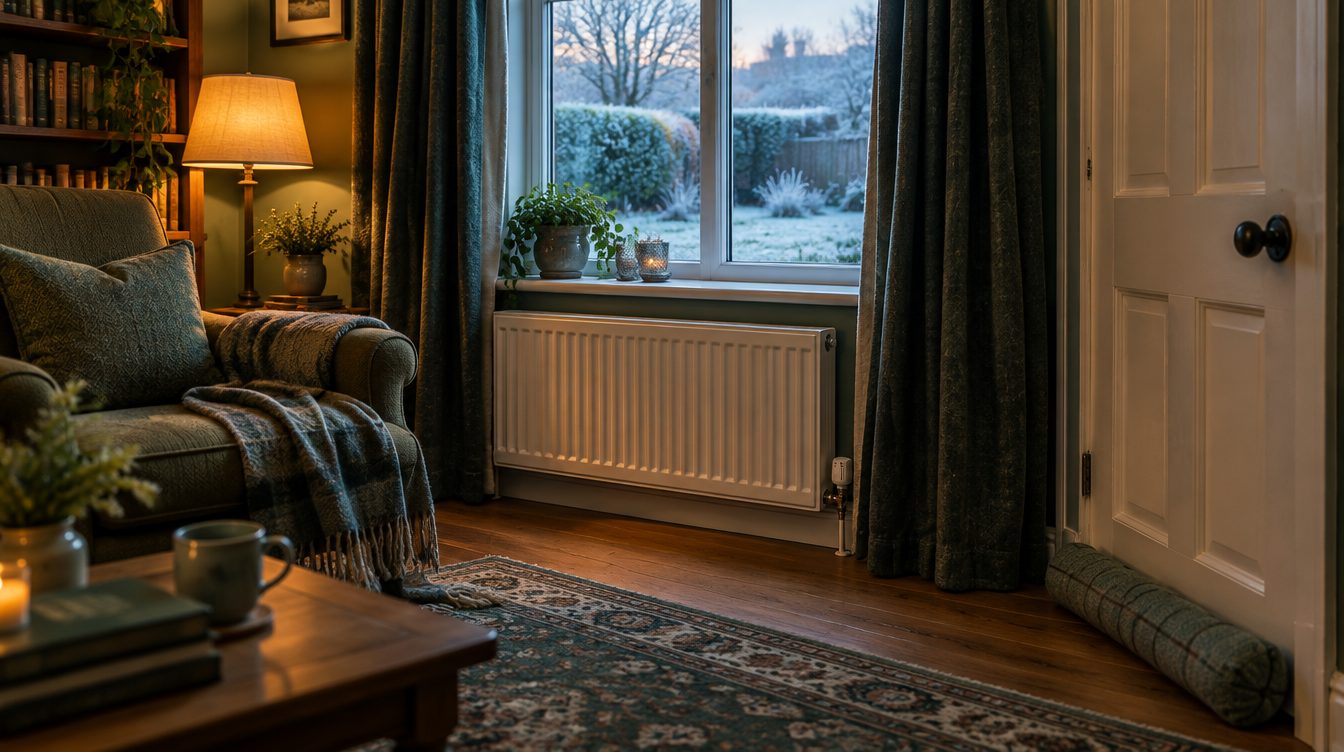
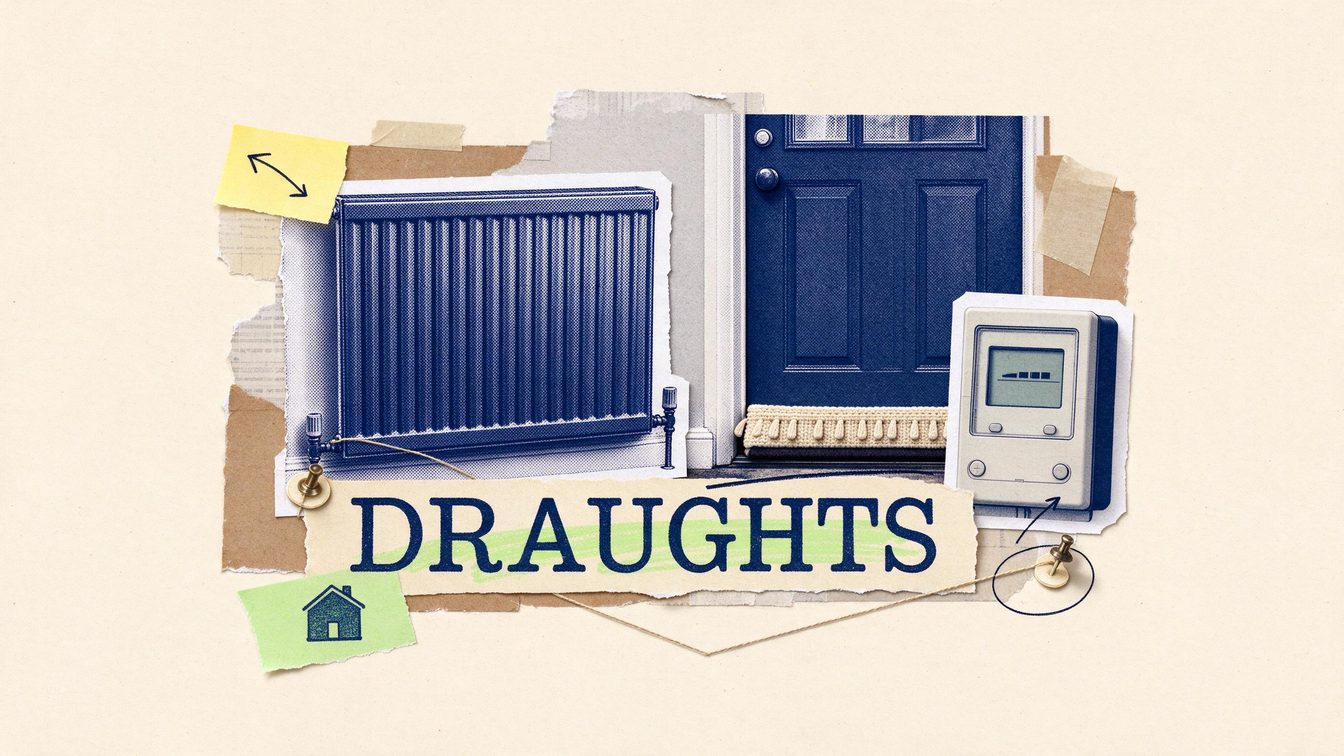
Older British homes leak air in lots of small places that each feel too minor to bother with: the letterbox, the keyhole, gaps under skirting boards, unused chimneys, badly fitting loft hatches, cat flaps. Draught excluders, brush strips and a chimney balloon cost very little and are some of the best-value things you can buy. One thing to be careful about: don't block ventilation that's there on purpose, like airbricks, extractor vents, or any room with a fuel-burning appliance.
Get your heating controls working
- Bleed the radiators. Air at the top of a radiator means the top isn't heating. It's free and takes minutes.
- Fit or set thermostatic radiator valves. Heating a spare room to the same temperature as the living room is pure waste.
- Set the timer to your actual routine instead of leaving it how the installer left it. Heating an empty house is about the most common avoidable cost there is.
- Insulate the hot water cylinder if you have one and it's bare or only thinly jacketed. A modern jacket pays for itself quickly.
Do the free things before you spend anything. Flow temperature, bleeding radiators, timer settings and draught-proofing cost next to nothing, and they're often worth more than an expensive upgrade put into a leaky house.
Tier 2: moderate spend, strong return
Loft insulation
The recommended depth in the UK is 270mm of mineral wool. A great many British lofts were done decades ago to a much thinner standard and never topped up, so it's well worth checking yours with a tape measure. Topping up is a straightforward job, and people often forget to insulate the loft hatch itself. If you use the loft for storage, boards laid straight onto the joists squash the insulation and ruin it, which is exactly why raised boarding systems exist.
Cavity wall insulation
If your house was built with a cavity, which is broadly from the 1920s onwards and increasingly standard after the 1930s, filling it is one of the better-value jobs going. Older homes usually have solid walls, which is a different and much more expensive problem. You can often tell from the brickwork: solid walls usually show alternating short and long bricks, while cavity walls show a uniform pattern of long bricks.
Two words of caution. Cavity fill isn't right for every property: homes in exposed coastal spots and walls in poor condition can end up with damp, so use an installer who'll survey properly and who's covered by a proper guarantee. And if your walls were filled decades ago, the material may have settled or broken down.
Floor and pipe insulation
Suspended timber ground floors, common in older British houses, lose a surprising amount of heat. Insulating between the joists is disruptive but works. Lagging exposed pipes in unheated spaces is cheap and quick by comparison.
Tier 3: big spend, long payback
These are real measures, but they come last, partly because they cost the most and partly because how well they work depends on the earlier tiers being done.
- Solid wall insulation, inside or out, is the right answer for pre-1920s solid-wall homes and the only way to fix their biggest heat loss. It's expensive and disruptive, though, and older buildings need careful attention to damp and breathability.
- Replacement glazing is worth it if your windows are failing or single-glazed, but on energy savings alone it takes a long time to pay back. Comfort and noise are often better reasons to do it.
- Heat pumps are efficient, and they're where UK home heating is heading, but they only work properly in a home that's already well insulated, with radiators sized to suit. There's grant support in parts of the UK; the schemes and amounts change, so check the current position before you budget.
- Solar panels and battery storage are about making energy rather than saving it. We cover them separately in backup power and solar.
Grants and schemes
There's support for insulation and heating work across the UK, and who qualifies usually depends on income, benefits, the property's EPC rating, or a mix of those. It works differently in England, Scotland, Wales and Northern Ireland, and schemes open, close and change their terms fairly often.
So the advice that lasts is about where to look rather than which scheme to pick. Start with the official government energy grants checker for your nation, and try your energy supplier as a second route, since obligations on suppliers pay for some of this work. Be wary of cold calls or doorstep offers about "free insulation". The genuine schemes don't need to cold-call you.
What about the EPC?
An Energy Performance Certificate gives you a rating from A to G and a list of suggested improvements. It's a handy starting point, especially if you've just moved and don't know the house's history. Treat it as a rough guide rather than gospel: assessments are fairly quick, assessors work from what they can see and make assumptions about what they can't, and a certificate can be up to ten years old. If yours says the loft is insulated, go up and measure it anyway.
The things that get talked about but barely matter
Standby power on modern appliances, unplugging phone chargers and swapping bulbs that are already efficient all make a real but small difference. Do them because they're free, not because they'll change your bill. If heating is most of your energy use, that's where your attention belongs, and an hour on flow temperature and draughts will beat a year of dutifully flicking plugs off.
 Home efficiency checklist
0 of 9 done
Frequently asked questions
What's the cheapest way to cut my energy bill in a UK home?
Turning down the radiator flow temperature on a condensing combi boiler, if nobody has touched it since installation. It costs nothing, takes minutes, and lets the boiler actually condense, which is the only condition under which it runs at its rated efficiency. The house still reaches the same temperature.
After that: bleeding radiators, resetting the heating timer to your real routine, and draught-proofing the letterbox, keyholes, loft hatch and any unused chimney. All are cheap, and in a leaky house they are frequently worth more than an expensive measure applied badly.
How deep should loft insulation be?
The recommended depth in the UK is 270mm of mineral wool. Many British lofts were insulated decades ago to a much shallower standard and never topped up, so it's worth taking a tape measure up rather than assuming, including checking the loft hatch itself, which is commonly missed.
If you store things in the loft, note that boards laid straight onto the joists compress the insulation and largely defeat it. Raised boarding systems exist to avoid exactly that.
How do I know if I have cavity walls or solid walls?
Broadly, UK homes built from the 1920s onwards tend to have cavity walls, and those built before that usually have solid walls. The brickwork is the quickest check: solid walls generally show an alternating pattern of short and long brick ends, while cavity walls show a uniform pattern of long bricks.
It matters because cavity wall insulation is relatively affordable and good value, whereas solid wall insulation is a much larger and more disruptive job.
Is cavity wall insulation ever a bad idea?
It can be. It isn't suitable for every property, exposed locations, particularly on the coast, and walls already in poor condition can develop damp problems after filling. Use an installer who surveys the property properly first and whose work comes with an appropriate guarantee.
If your cavity was filled many years ago, the material may also have settled or degraded, which is worth investigating before assuming the walls are dealt with.
Are heat pumps worth it in the UK?
They're efficient and they're the direction UK home heating is going, but they aren't a drop-in replacement. A heat pump runs at lower flow temperatures than a gas boiler, so it performs well only in a home that's already well insulated and has appropriately sized radiators. Installing one into a leaky house with small radiators is how people end up disappointed.
Grant support exists in parts of the UK, but scheme terms and amounts change regularly, so check the current position for your nation rather than relying on a figure quoted in an article.
Does switching off standby actually save much?
Barely, on modern appliances. It's free so there's no reason not to, but it won't noticeably change your bill.
The reason it gets so much attention is that it's easy to describe, not that it's effective. In a typical British home the majority of energy goes on space and water heating, so that's where the meaningful savings are. An hour spent on flow temperature and draught-proofing will outperform a year of conscientious plug-switching.
What if your income halved tomorrow?
A lower energy bill is not just a saving. It permanently lowers the floor your household has to clear, which is what decides whether an income shock is survivable.
Read itWhere to go next
- Backup power and solar: how to size it right
- Growing and preserving food that actually saves money
- The 30-Day Resilience Starter
- What if your income halved tomorrow?: why a lower energy bill lowers your risk, not just your costs.
- What if energy prices spiked again?: how a rise reaches your bill, and what the price cap does and doesn't protect.
Sources & methodology
This article deliberately avoids quoting the current price cap, grant amounts or scheme names, because all three change regularly and a frozen figure would mislead. Check these directly:
- Ofgem: the energy price cap, updated quarterly, and what the unit rate and standing charge currently are.
- gov.uk, energy grants and efficiency: the official checker for support schemes in your nation. Provision differs across England, Scotland, Wales and Northern Ireland.
- The 270mm loft insulation depth is long-standing UK guidance. Cavity versus solid wall construction eras are general rules of thumb; a surveyor should confirm before any cavity fill.
Never alter gas appliances yourself, boiler work in the UK must be carried out by a Gas Safe registered engineer.