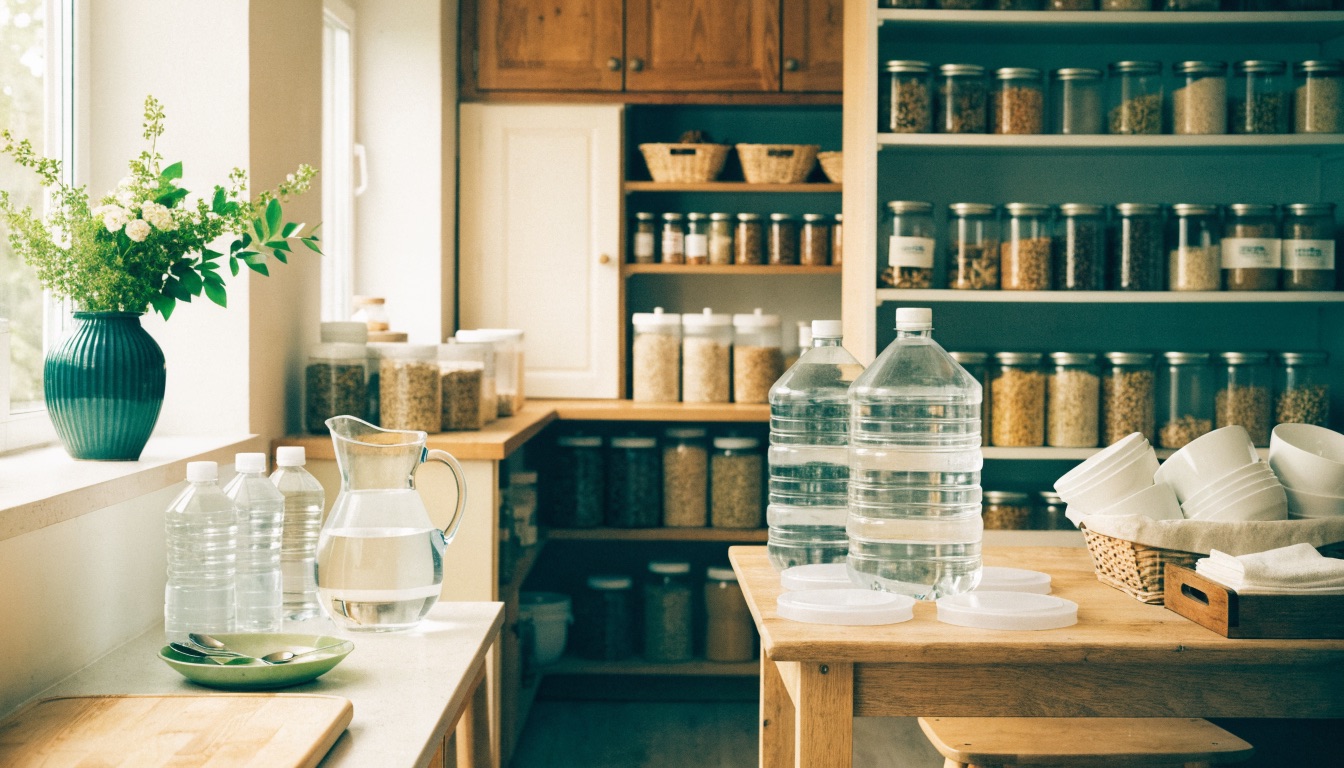
Official UK advice is refreshingly honest here: gov.uk deliberately doesn't tell you how much water to store. Its Prepare campaign says there's no standard figure, because emergencies vary in length and people use different amounts. That's more useful than a made-up number, because it means the real job is doing the sums for your own household instead of copying someone else's total.
As a starting point, plan to manage for at least 72 hours without mains water or shops, and longer if you have the space. For water, the survival minimum is about 2.5 to 3 litres per person per day just for drinking. Around 10 litres per person per day is what makes you properly comfortable once cooking and basic washing are included.
Sources: gov.uk Prepare: get prepared for emergencies; drinking-water minimum per World Health Organization guidance cited there.
Work out your own number
The calculation is deliberately simple, and doing it yourself beats any figure in an article:
people × litres per day × days = litres to store
So for a household of four planning for three days, four people × 3 litres × 3 days comes to 36 litres for drinking. That's about eight of the big 5-litre supermarket bottles, or one shelf. Plan the same three days at the comfort figure of 10 litres each and you need 120 litres, which is a different matter and probably means a garage or the cupboard under the stairs.
Most people find the drinking-only number reassuringly small and the comfort number surprisingly big. It's worth knowing both, because they cover different levels of disruption.
Add a margin if anyone at home needs water for baby formula, medical devices or pets. gov.uk mentions these specifically, and they're easy to forget when you're counting heads.
A UK-specific point worth knowing. A power cut doesn't usually stop your mains water, because much of the British supply is gravity or pressure fed. It does affect you if you live in a high-rise flat with electric pumps, or rely on a private supply. What a power cut will take away is boiling water on an electric hob, which is a good reason to keep some ready-to-drink water rather than assuming you can treat whatever comes out of the tap.
How long should you actually plan for?
Start with 72 hours. That's what official UK guidance and the British Red Cross both point to, and it covers the vast majority of real disruptions here. Stretch it to a week if you have somewhere to put it all.
You'll find plenty online arguing for much longer. Some of it's reasonable and some of it is selling something. For most British households the first three days give you most of the benefit, the next four are cheap insurance if you have the room, and beyond that you're into a different hobby with different trade-offs.
Food: what three days to a week looks like
Budget roughly 2,000 calories per person per day as a planning figure, and adjust for who actually lives with you. For one adult that's about 6,000 calories over three days and about 14,000 over a week, which ordinary store-cupboard food covers easily.
gov.uk's recommendation is worth following to the letter: non-perishable food that doesn't need cooking. Think tinned meat, fish, fruit and vegetables, and ready-to-eat things. Add a manual tin opener, which is the thing people most often forget in an emergency cupboard. The logic is that whatever cuts off your food supply often stops you cooking at the same time.
There are two ways to build it. You can rotate what you already eat, which costs least and wastes nothing because it moves through your normal shopping. Or you can add purpose-made long-life food as a backstop you don't rotate, which costs more per meal but needs no looking after. Most plans that work use rotation for the bulk and keep a small amount of long-life food in reserve. There's more on this, including growing and preserving your own, in growing and preserving food that saves money.
Don't forget the pet food. It's in the official guidance for a reason.
Filtering matters as much as storing. A portable water filter is a small, cheap addition that gives you more options if your stored water runs low.
 Your 2-week food and water checklist
0 of 9 done
Frequently asked questions
How much food should I store for two weeks?
Budget roughly 2,000 calories per person per day, which works out at about 28,000 calories for one adult over two weeks. Multiply by household size and add a margin for anyone with higher energy needs. Two weeks (not three days) is the target worth planning against, because real disruptions to food access have been running two to six weeks, driven as much by supply chain strain as by the initial event.
How much water do I need per person per day?
About 2.5 to 3 litres per person per day covers drinking alone, which is the survival minimum cited in UK guidance. Around 10 litres per person per day is what makes you genuinely comfortable once cooking and basic hygiene are included. Work out your own total as people × litres per day × days: for a family of four over three days that is 36 litres for drinking, or 120 litres at the comfort figure. Add extra for baby formula, medical devices and pets.
Is a 72-hour emergency kit enough?
For most British households, yes, 72 hours is the horizon that gov.uk Prepare and the British Red Cross both point at, and it covers the large majority of real disruptions here. Extending to a week is sensible if you have somewhere to put it. Beyond that you are making a judgement about risks specific to where you live, such as a private water supply or a rural area prone to long weather-driven power cuts.
What's the cheapest way to build a two-week food supply?
Rotate what you already eat. Buying extra of the shelf-stable staples already in your diet (rice, pasta, pulses, tinned goods) and using the oldest stock first costs the least and wastes nothing, because nothing is bought specifically to sit unused. The alternative is purpose-built long-life food as a non-rotating backbone: freeze-dried meals run 25–30 years of shelf life, while dehydrated bucket options cost less per serving and still last 10–25 years. Most workable plans use both, with rotation as the bulk and long-life food as the reserve.
Do I need a water filter if I'm already storing water?
Storage and filtration solve different problems, and filtration is the cheaper of the two to add. Stored water is finite and bulky (120 litres takes real space) whereas a portable filtration system meaningfully extends your options if stored water runs low or if what's available needs treating. Treat filtration as the low-cost insurance on top of storage rather than a replacement for it, and follow the manufacturer's guidance on what a given filter does and doesn't remove.
How often should I rotate stored food and water?
Follow the manufacturer's dates rather than a general rule, since shelf life varies enormously between tinned goods, dried staples and purpose-built emergency food. The practical habit is to check stock on a fixed schedule (a calendar reminder twice a year works for most people) and to use the oldest items in normal cooking so rotation happens through your ordinary shopping rather than as a separate chore. Storage conditions matter as much as dates: cool, dark and dry extends life, heat shortens it.
Where this fits with the rest of the site
Food and water resilience follows the same logic as the AI job resilience pillar: know your actual exposure, build realistic runway, and have a plan before you need one. If you haven't already built your financial runway, see Build a 6-Month Income Backup Plan: a disruption that hits your pantry can hit your paycheck too.
Sources & methodology
The water and food figures on this page come from official UK preparedness guidance rather than from US sources, which use different units and assumptions.
- gov.uk Prepare, get prepared for emergencies: the 2.5–3 litre drinking minimum (per WHO guidance cited there), the 10 litre comfort figure including cooking and hygiene, the deliberate absence of any prescribed stockpile total, the recommendation for non-perishable food that needs no cooking, and the reminders about baby formula, medical devices and pets.
- The 72-hour planning horizon reflects gov.uk Prepare and British Red Cross guidance.
What was removed, and why. An earlier version was built around US data: a "3.7 days of food" figure for American households, FEMA and World Food Programme claims, water budgeted in gallons, and an unsupported assertion that real disruptions "commonly last 2 to 6 weeks". None of it was appropriate for a UK audience and the 2–6 week claim was not traceable. Updated 20 September 2026.