AI answers read well. They're tidy, fluent and confident whether or not they're right, and the tone of an answer tells you nothing about whether it's true.
Here's a neat example. In 2025 the consumer group Which? asked six AI tools about 40 everyday questions on money, law, health and consumer rights. One question asked how to invest a "£25k annual ISA allowance". The real allowance is £20,000, and the £25k was a deliberate error. According to Which?, ChatGPT and Copilot missed it entirely and gave advice that risked oversubscribing to ISAs in breach of HMRC rules, while Gemini, Meta AI and Perplexity corrected it. So two out of six missed a mistake that one look at gov.uk would have caught.
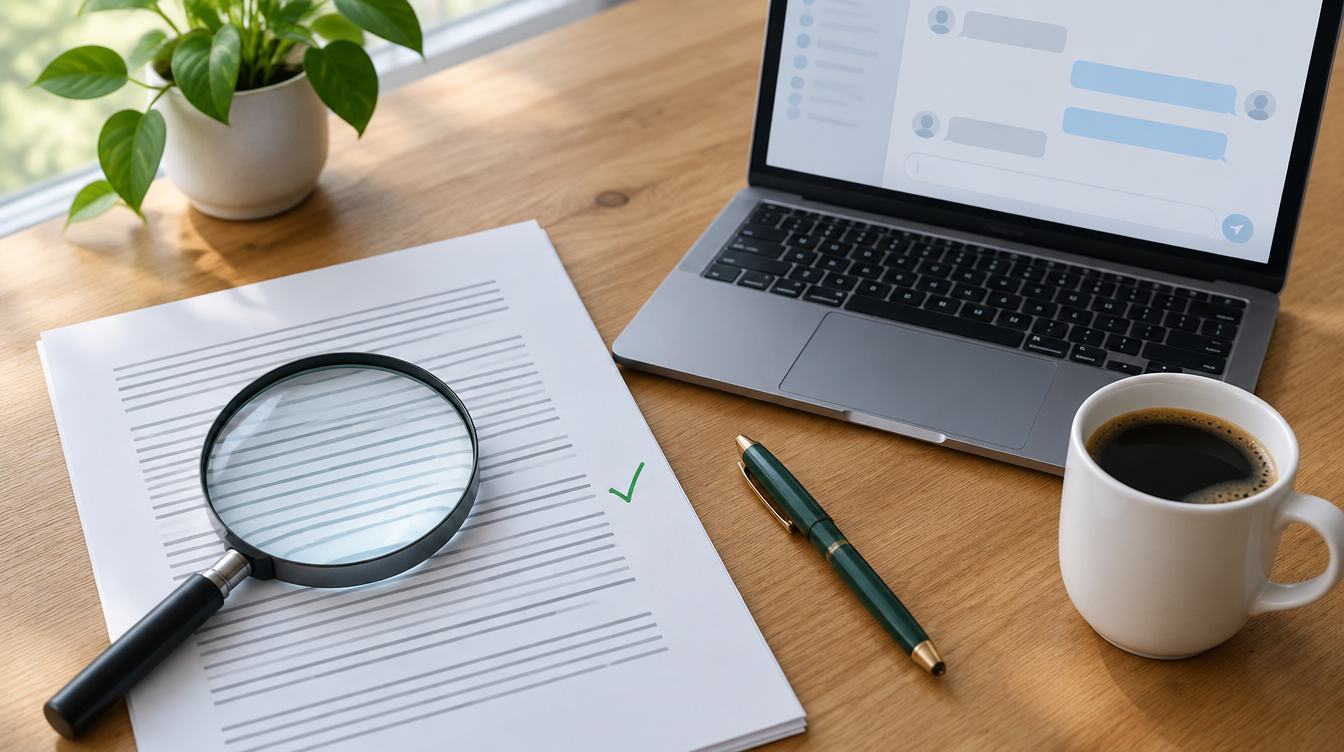
Treat an AI answer as a first draft and a pointer, not a source. The more it matters (money, health, the law, anything you'll sign, send or act on), the more carefully you check it against the original, official page, or with a professional. For low-stakes stuff, a glance is enough. Below are five checks and a way to decide how many you need.
Why a confident answer isn't evidence
Underneath, a chatbot is predicting text, not checking facts. England and Wales's judiciary puts it plainly in its guidance for judges: what a chatbot produces is what the model predicts to be the most likely combination of words, and "not necessarily the most accurate answer". OpenAI's own help page admits as much: ChatGPT can produce incorrect or misleading outputs, and "confidence isn't reliability". The NCSC made the same point in 2023, noting that these tools can get things wrong, "hallucinate" incorrect facts, and are often gullible when asked leading questions.
In practice the mistakes come in four kinds, and recent testing has an example of each:
- Some are made up. OpenAI lists fabricated quotes, studies, citations and references to sources that don't exist. In a July 2026 Which? test on personal finance, when asked for the best savings rates, ChatGPT "hallucinated a non-existent product".
- Some are out of date. In the same test, Which? says ChatGPT sent people to the Pensions Advisory Service, which no longer exists, and Copilot and Google's AI Overviews quoted capital gains tax rates that haven't applied since October 2024.
- Some are for the wrong country. Which? found that unless the question made clear the user was in the UK, the chatbots tended to give US-centric answers, such as American look-back periods for travel insurance. Earlier testing found the tools often missed that rules differ across the UK's nations.
- Some have weak or missing sources. Which? repeatedly saw sources that were vague, non-existent or dubious, such as old forum threads. The EBU and BBC study found serious sourcing problems in nearly a third of the answers it checked.
When it goes wrong in public
The courts have had to deal with this head on. In June 2025 the Divisional Court heard referrals about the actual or suspected use of AI by lawyers, where false information, typically a fake citation or quotation, had been put before it. It set out the risk in its judgment: these tools "can produce apparently coherent and plausible responses" that "may turn out to be entirely incorrect", may make confident assertions that are simply untrue, and may cite sources that do not exist. It said people who use them for legal research have a professional duty to check the results against authoritative sources.
The judiciary's own guidance, updated in October 2025, says that the accuracy of any information from an AI tool "must be checked before it is used or relied upon", and that even cited source material might itself be made up. It adds that people representing themselves in court, and using chatbots to prepare their papers, rarely have the skills to verify what they're given, and are responsible for what they put to the court. You don't need to be in court for the lesson to apply: if a letter, a form, a claim or a CV goes out in your name, the mistake in it is yours.
Match the effort to the stakes
You don't need to fact-check a dinner recipe. Here's a simple sliding scale, which is ours rather than an official one.
- Low stakesGlanceIdeas, rewording, a first draft
- MediumCheck the key factsNames, numbers, claims you'll repeat
- HighOfficial source or a professionalMoney, health, law, safety, anything you'll sign
- Low stakes (ideas, rewording, a first draft, a holiday shortlist): read it critically and move on. If it's wrong, you've lost very little.
- Medium (facts you'll repeat, claims in work, figures in a report): check the key facts, names and numbers against one reliable source before you use them.
- High (money, health, legal rights, safety, anything you'll sign or submit): don't rely on the chatbot at all. Use the official page, and a professional where it matters. Which? says that for legal, medical and financial questions, always seek professional advice before making any decisions. In Which?'s July 2026 test, OpenAI and Microsoft each said their tools are not a substitute for or a replacement for professional advice, and Google said it recommends consulting a professional on legal, medical or financial matters.
Five checks that take minutes
- 1SourceAsk for it, then open it
- 2NumbersCheck them on the official page
- 3Place and dateSay where you are and what day it is
- 4Neutral questionDon't build your assumption in
- 5WorkingMake it show quotes and say 'I don't know'
- Ask for the source, then open it. Trust the page rather than the citation. Does the link work? Does the page really say what the AI says it does? Is it the original source, such as a government site, the regulator or the company itself, or someone else's summary of it? OpenAI's own advice is to use search or deep research, and to check sources by visiting the links directly when accuracy matters.
- Check the numbers, dates and names that matter. Rates, allowances, deadlines, thresholds, phone numbers, legal limits: look them up on the official page. This is where the ISA error and the out-of-date tax rates came from. OpenAI says to always verify quotes, data, technical information and references to external documents.
- Tell it where you are and what day it is. Say "I'm in England" (or Scotland, Wales, Northern Ireland, or wherever you are), and ask which date the information is from. The July 2026 Which? test shows what happens if you don't. And check the "last updated" date on any page you land on.
- Don't lead it, and don't assume it will catch your mistakes. The ISA test shows two of the six tools accepted a wrong figure and ran with it. Ask neutral questions ("what is the annual ISA allowance?") rather than building your own assumption into the question.
- Make it show its working. Anthropic's guidance for developers, which works just as well in an ordinary chat, suggests giving the model explicit permission to say "I don't know", asking for word-for-word quotes first when it's working from a long document you've supplied, asking it to find a supporting quote for each claim and drop any it can't support, and running the same question more than once, because inconsistent answers can be a sign of hallucination. Anthropic is clear that these techniques reduce hallucinations but "don't eliminate them", and that you should always validate critical information.
Red flags
- A citation, case, study or quote you can't find anywhere when you search for it.
- A very specific figure, with no source, on something you'd act on.
- A confident answer to a question that depends on your circumstances, with no mention of your country, your age, your tenancy or your contract.
- Never suggesting you speak to a professional, on legal, medical or money questions. Which? was surprised how rarely the tools did.
- Links to premium services where a free official one exists, such as paid tax-refund companies instead of the free HMRC tool, which Which? saw in its testing.
- American spellings, laws or cases in an answer about the UK. The judiciary lists American spelling and references to overseas cases among the indications that work may have been produced by AI.
Where AI answers are good
None of this means you shouldn't use them. Which? says the tools "already do a good job of reading the web for you" and pulling together a digestible summary, and that for basic research they can be very useful. The judiciary suggests they are most useful for reminding you of material you'd recognise as correct, rather than for finding something new you can't verify. OpenAI's advice is to use ChatGPT "as a first draft, not a final source". That's a good way to think of it: it gets you started quickly, and you finish the job.
If you've already acted on a wrong answer
- Check the official source today and find out exactly what was wrong.
- If it was money, a deadline or a contract, contact the organisation involved. Owning up to a mistake yourself is almost always better than waiting for them to spot it. That's our advice rather than a rule.
- If you sent or submitted something, say so and correct it. You remain responsible for what goes out in your name, whatever tool wrote it.
- If it affects your health or safety, speak to a GP, pharmacist or NHS 111 rather than going back to the chatbot.
 Before you rely on it
0 of 9 done
The two-futures view
If AI answers keep getting better, the people who gain most will be the ones who already check what matters, because they'll move faster by trusting the right things. If the tools get worse, or you can't get to them, or the web fills up with machine-written errors, the habit of going straight to the official page, the original document or a real person is what you fall back on. It takes a few minutes today, and it protects you either way.
What not to paste into an AI chatbot
This article is about what comes out of an AI. The companion piece covers what you put in, and what ChatGPT, Claude, Gemini and Copilot say they do with it.
Read itFrequently asked questions
Why does AI make things up?
Because it generates the most likely words, not a checked fact. The judiciary's guidance says what a chatbot produces is what the model predicts to be the most likely combination of words, and is not necessarily the most accurate answer. OpenAI defines these errors, often called hallucinations, as responses that aren't factually accurate, such as fabricated quotes, studies or citations, and says the model can sound confident even when it is wrong.
Can I trust an AI answer if it gives sources?
Not without opening them. Which? repeatedly found sources that were vague, non-existent or dubious, and the EBU and BBC study found serious sourcing problems in 31% of the answers it assessed. Check that the link works, that the page says what the AI claims, and that it's an original or official source, not a summary of one.
Which AI is the most accurate?
There's no reliable single answer. The tools rank differently in different tests and change over time, and in the September 2025 Which? test and the EBU and BBC study, every tool assessed made errors. Pick the tool you like, and check what matters, whichever you use.
Are Google's AI Overviews more reliable than a chatbot?
Not necessarily. In its September 2025 test Which? found the two Google tools gave noticeably different quality on the same questions, and noted that the AI Overview lets you review the links it shows, but that one wasn't shown for every question (28 of 40). Either way, open the links.
Can I just ask the AI to check its own answer?
It can help, but it isn't independent. Anthropic's guidance suggests asking a model to find a supporting quote for each claim and drop any it can't support, and comparing answers across several runs, but says these techniques reduce hallucinations and don't eliminate them. Use them to find problems quickly, then check the important points against an official source.
Is it safe to use AI for medical, legal or money questions?
Not as your only source. Which? advises always seeking professional advice before decisions on legal, medical and financial matters. In its July 2026 test, OpenAI and Microsoft each said their tools aren't a substitute for professional advice, and Google said it recommends consulting a professional on such topics. AI can help you prepare questions, understand terms or draft a letter; the answer you act on should come from an official source or a qualified person.
Why does the AI give me American answers?
Which? found that unless a question made clear the user was in the UK, the chatbots tended to give US-centric information. Say where you live, and check that any rules, rates or contact details it gives are the UK's, and for the right part of the UK.
What should I do if I've used a wrong AI answer?
Check the official source straight away, contact the organisation involved if money, a deadline or a contract is affected, and correct anything you've sent or submitted. You remain responsible for what goes out in your name.
Where to go next
- What not to paste into an AI chatbot: the companion piece: what goes in, and what the providers say they do with it.
- AI is making scams more convincing: when the wrong answer is deliberate.
- The AI toolkit worth paying for: which tools earn a subscription, and the checks before you pay.
- Automate the boring half of your small business: why you test with fake data and watch it for a week.
- Learn anything faster with an AI tutor: the hopeful side, using AI to get sharper rather than skip the thinking.
Sources & methodology
All pages were read on 8 October 2026. Test results are snapshots: AI tools change often, and the Which? tests below were run in September 2025 and mid-2026 on the versions then available. We don't quote any ranking of one tool against another, because the results differ between tests and over time, and in the 2025 tests every tool assessed made errors.
- Which?, "Can you trust AI? ChatGPT and other AI chatbots put to the test" (18 November 2025): six tools, 40 questions, the ISA allowance error, weak sources, advice to seek professional advice, the companies' responses. Which?.
- Which?, "Can AI answer your money questions?" (23 July 2026): 15 personal finance questions, the non-existent savings product, outdated pension and capital gains tax information, US-centric answers. Which?.
- BBC Media Centre, on the EBU-coordinated, BBC-led "News Integrity in AI Assistants" study (22 October 2025): 45%, 31% and the BBC's audience research on trust in AI summaries. BBC.
- Courts and Tribunals Judiciary, AI guidance for judicial office holders (31 October 2025 edition, PDF): the "most likely combination of words" explanation, the accuracy requirement, hallucinations and indications that text came from a chatbot.
- Ayinde v London Borough of Haringey and Al-Haroun v Qatar National Bank (Divisional Court, 6 June 2025): the court's statement on the risks of using AI tools for legal research.
- OpenAI, Does ChatGPT tell the truth?: hallucination examples, "confidence isn't reliability", and its tips for verifying.
- Anthropic, Reduce hallucinations (Claude documentation, written for developers): the techniques described in check 5.
- NCSC, "ChatGPT and large language models: what's the risk?" (14 March 2023): used only for the statement that these tools can get things wrong and hallucinate, and are often gullible when asked leading questions.
The sliding scale of stakes, the red-flags list and the "if you've already acted" steps are our own suggestions. We have not tested any chatbot for this article. What If Hub currently earns no commission from any provider mentioned. See the commercial policy.